

Bazaar Wars: The Qalandar Writes Back
The gift of literacy in a cruel world.

History is written by the victors, or so we are told. The losers are left to twiddle their thumbs, anticipating either a distorted image, or perhaps a complete erasure from historical records. The losers of history however, have a tool, a weapon at their disposal to preserve their communal identity. Their stories and hopes and dreams. They can write and document, preserving an underground history of sorts that simmers beneath the official history and emerges at a more opportune time.
But what happens when the losers cannot read or write? Who is left to tell their story?
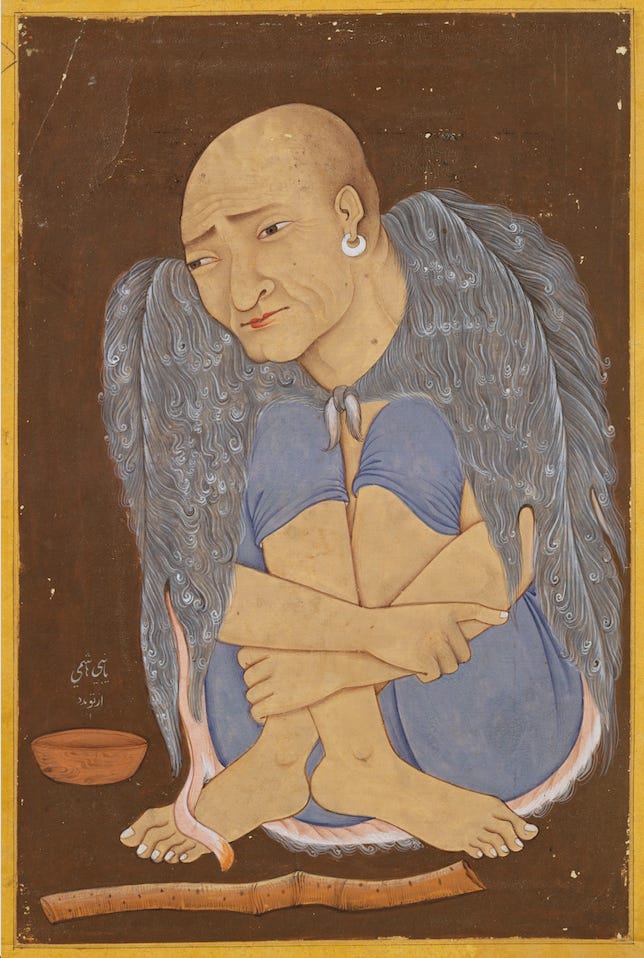
Which brings us to the Qalandar Sufis.
If history is written by the victors, then in Islamic history, the victors are everyone but the Qalandars. Nearly all historical sources — be they authored by historians, jurists, or other more orthodox Sufis — have lambasted the Qalandars for their disregard of Islamic law and societal norms; they were depicted as alcoholic antinomians who roamed the lands and wrought havoc wherever they went. Amongst a sea of easy targets, they were the sitting ducklings of the Islamic world.
Were the Qalandar Sufis guilty of all that they were accused of? Perhaps. The fact that multiple, opposing factions were all united in their attacks on the Qalandar Sufis indicates that there is a strong probability that their attacks possessed legitimacy. The crucial point, however, is that we are hard-pressed to find the Qalandar perspective. The Qalandar eschewed literacy, believing that formal education was a barrier to spiritual progress. For this reason, an authentic Qalandar perspective has been lost to history . . . which makes the Sulīmān Shāh Qalandar-nāma manuscript I came across last week all the more relevant.1
The treatise is authored by an unnamed Qalandar and dedicated to Shah Sulayman, the Safavid sovereign. In the treatise the author outlines the Qalandar worldview and provides a greater insight to Qalandar practices. Of interest to us (me) are the Persian poems composed by the author. The verses are as follows:
Knowing the wisdom of religion is the sharīat.
When you put it into practice it is the ṭarīqat,
Once wisdom and practice are joined together
For the sake of the Truth’s satisfaction it is the ḥaqīqat
Turn to the sharīat. Know the ṭarīqat. Practice the ḥaqīqat.
Because sugar, oil and wheat mixed together make halva.
Here in these verses, the author claims that the Qalandariyyah adhere to orthodox beliefs and practices; that the Shariah is a crucial part of their worldview and forms a key component of the spiritual path.
Should we accept these verses as an accurate representation of the Qalandar worldview? Perhaps we should. Maybe not. Heck, I don’t know. But the treatise retains enormous value, not only for its exposition of the Qalandar perspective, but for the demonstration of the power of literacy; a power, or gift, that grants a voice to the voiceless.
I came across the treatise and the translations of Persian poetry in the following paper: Ridgeon, L. (2017) Short back and sides: were the Qalandars of late Safavid Iran domesticated? Journal of Sufi Studies, 6(1), pp. 82-115.
Like modern day antinomnian orders, the qalandar would probably have understood shariah differently.
Fun fact: whenever Iqbal uses Sufi in his poetry, it is derogatory. But Qalandar and Darvesh is laudatory.