

The Half-Dead Muslim
My first ever Persian translation from back in 2020.

I was 4 months into my Persian language course in Iran when COVID arrived and tossed my plans into the nearest bin. Stuck in an apartment in a foreign country, with a language I was still learning, I decided to do the most rational thing: practice my translation skills.
But what to translate with the half-baked Persian that I learnt? I decided it would be a passage from one of my favourite scholars and martyrs, Murtada Mutahhari. Shahid (martyr) Mutahhari was that rare scholar who was equally comfortable composing complex commentaries on the most difficult philosophical treatises as he was lecturing widely and disseminating knowledge to public audiences.
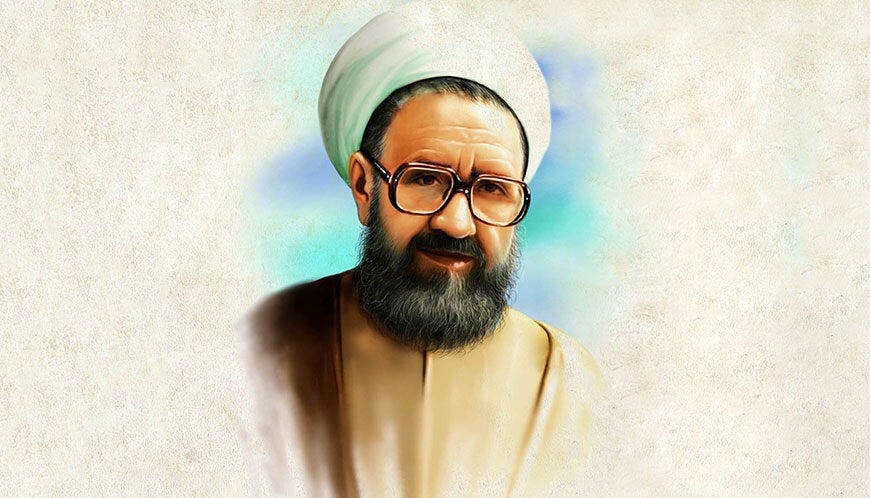
Along with being an erudite scholar and professor of philosophy, Shahid Mutahhari was also an influential figure in the Islamic Revolution of Iran. He was a key figure in mobilising popular political opposition against the Shah, and along with Ali Shariati and Mehdi Bazargan, was a prominent lecturer at Hosseiniyah Irshad, a central political and cultural hub of revolutionary activity. Along with his public lectures, his books helped revive a political consciousness informed by religious principles, in a time where Marxism and other fashionable isms were prevalent in the Muslim world.
It was one of these books — which is actually a collection of his public speeches — that I turned to for translation practice. I read one of his speeches about the Revival of Religious Thought, and was struck by one of the passages. I spent roughly two hours translating the passage, and was pleased with myself that I had translated something for the first time.
Now, five years later, I returned to the passage and double-checked the translation (and asked Ustad Peyman Eshaghi to check it). With a few minor corrections, I present it here today for the passage’s resonance.
Though some of the language is dated — and it is a speech so the structure shifts randomly at times — the core message of Shahid Mutahhari rings true today, particularly when Arab leaders are bending over backwards to shake hands with Donald Trump whilst Gazans are being genocided.
The politics that governs the world — or at least half the world — wants Islam to neither die nor live, but rather to remain in a state of half-life and half-death. The world is divided into two so-called blocs: East and West. These two blocks agree on two issues: One is the issue of Germany, and the latter is the issue of Islam. As for Germany, however, though they appear to have different ideas, secretly they both agree that it should not return and should not let it develop and thrive. Regarding Islam it is exactly the same, but the difference is the East thinks of completely uprooting Islam, whereas the West think they should preserve Islam in a state of half-death and half-life, meaning the state it currently possesses. They want to protect the current status quo; neither allowing it to perish, nor allowing it to truly come to life.
An apt example is that which is mentioned in books of entomology and psychology, wherein they study and investigate instincts. In regard to an insect — which is smaller than a bee yet larger than a fly — they say that it possesses such strange instincts that materialists are at a loss to explain these instincts. They say that when the time comes for this insect to lay eggs, it finds a worm and makes its way onto its back. Once there, it finds a very delicate nerve — which is in a specific part of the body — and stings it there. But the sting that it delivers is not a fatal sting. If it wanted to sting it and kill it, it could’ve done so. But it stings it softly, to the degree that the nerve becomes numb and the insect loses feeling and drops down exactly where it is, but does not die. After that the insect lays its eggs upon the back of this worm. What is wondrous is that after it has laid its eggs, but before its offspring emerge from the eggs, it dies. In this way past and future generations of this insect never see each other. Soon its offspring will emerge and grow, and when they want to eat they will eat the flesh of the worm. They will eat it until they’ve devoured it, and after that they will leave.
So why does this insect not deliver a fatal sting to the worm? Because if the worm dies, it will quickly rot and decay. So why sting it? So that it becomes numb and is unable to move. If it could move, then the insect would not be able to lay eggs upon its back, and its offspring would not be able to feed off the worm. In this way its state of half-life and half-death is preserved in a way that it does not die, nor is it able to move. What is wondrous about this insect is that after it dies, the succeeding generation does not see the previous generation. When the offspring grow and want to lay eggs, they carry out the same action with the same skill as the previous generation without having seen them or learnt from them.
This is the state of half-death.
- Murtada Mutahhari, Ten Speeches, p.158-159.
On 1st May 1979, Murtada Mutahhari was gunned down in Tehran by members of the Furqan group. He was 60 years old. For his soul and the souls of the martyrs, please recite surat al-Fatiha.
I’ve added two of my favourite videos here of the martyr for those interested. They are only a few minutes long each, but well worth the watch.
Thank you for posting this - he was a truly remarkable scholar and many of his writings, as you show, are very relevant today. The excellent translation of his book “Fundamentals of Islamic Thought: God, Man, and the Universe” is a true classic and one of my favorite reads.
Very insightful.